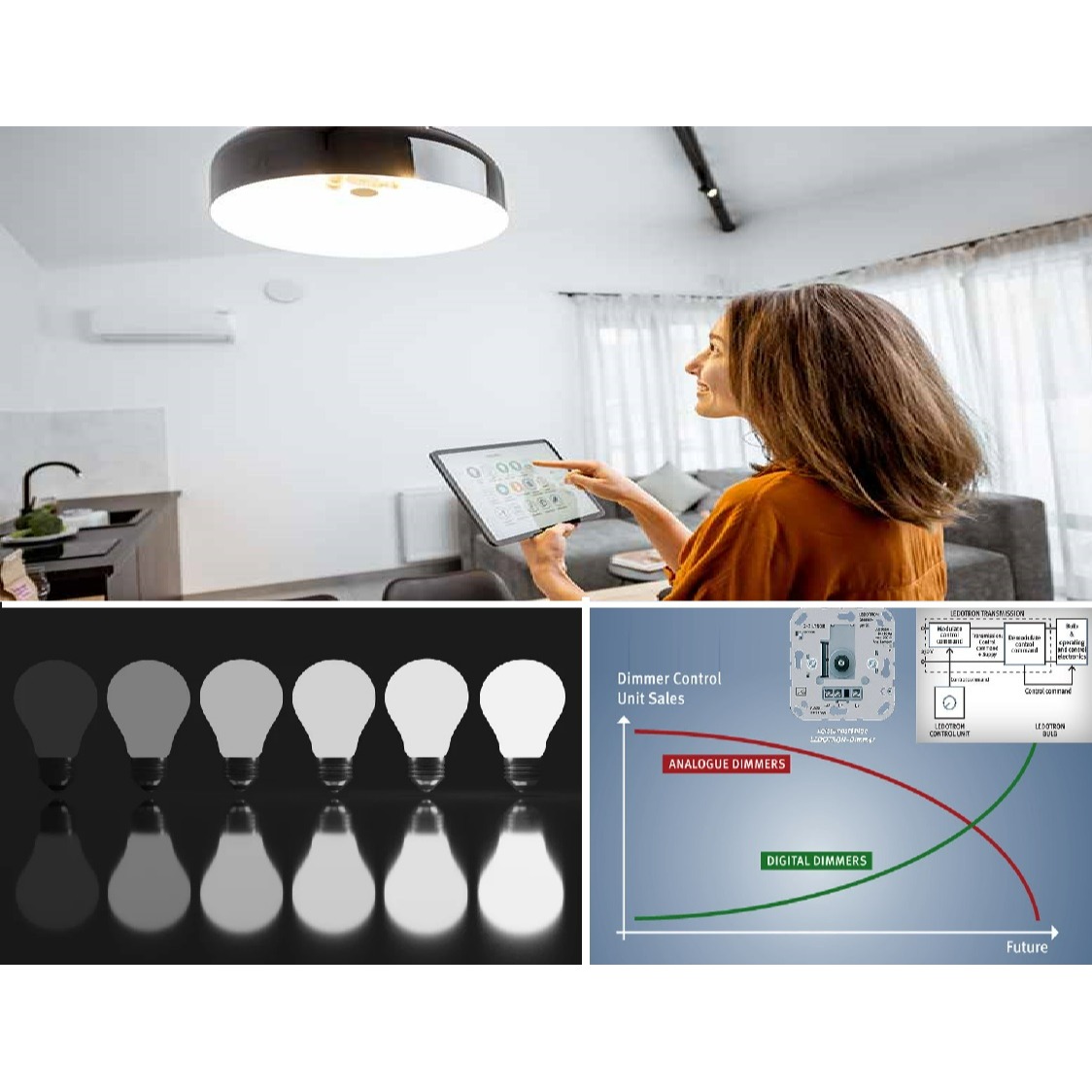
Dimming
Technology
Dimming systems are the ideal way to adjust
lighting intensity. Dimmers allow you to adjust the output levels of your
lights, and are a great way to get the perfect ambiance and lighting levels in
any space. They’re useful for creating the ideal atmosphere or to reflect a
specific time of day by complementing or offsetting the amount of daylight
coming into a space. For example, if you\'ve installed dimmers in your living
room, you\'ll be able to easily darken the room while you’re watching a movie,
but brighten it if you want to read or work.
There
are a variety of benefits dimmers offer, in addition to giving the user
complete lighting control. Dimmers can actually increase the lifespan of your
fixtures and reduce your energy consumption, since they reduce the wattage used
by a connected fixture, so they’re excellent for installation in both
residential and commercial spaces. You’ll always want to choose a dimmer that’s
compatible with your specific light fixture or lamp. You need to match the
dimmer to your load, because individual fixture characteristics require
specific dimming technologies for safe, quality installation.
There
are various dimming technology to dim specific lightings like :- Forward Phase,
Reverse Phase, DALI Dimming, 0-10 & 1-10 Dimming, DMX, Switch Dim, Phase
cut. But before jumping to it directly lets go learn about LED lights.
Can
LEDs be Dimmed?
Yes,
all LEDs can be dimmed, but it is not always simple. If it is practical or not
to dim a particular LED lamp or lighting fixture will depend on the driver that
is being used to control it. So, to answer the question “Can these specific
LEDs be dimmed?” it is necessary first to understand a little about LEDs and
drivers.
All
LEDs need a driver, which is a piece of electronics. Its main function is to
run the LEDs at the correct voltage and current, converting the mains AC supply
(typically 230V, 50Hz) to, usually 12 or 24V DC. This is necessary because LEDs
don’t operate on mains. LEDs work at low voltages on direct current.
In
commercial lighting fixtures,
such as LED panels, downlights and spotlights, the driver is usually separate
from the fixture. This means that the driver is accessible to the installer so
that, if the driver is the appropriate type, dimming control wires, in addition
to the mains supply wires, can be connected to it.
In
LED panel with its driver. The driver is separate from the panel, so it is
accessible for the connection of dimming control wires if required.
In
LED lamps the driver is built-in and cannot be accessed. The LEDs and
driver come as a single sealed item.
An
LED lamp. The driver is in the lamp base and the unit is sealed, so there is no
possibility of connecting any dimming control wires.
So,
to answer the very general question “Can LEDs be dimmed, and how do you do
that?” one first has to determine if the driver is separate and accessible or
if it is integrated with the LEDs.
Dimming
LEDs which has separate Driver
If
the driver is separate from the lighting fixture, or is accessible within it,
then the best way to dim the LEDs will be by using a dimming driver. This is
how most dimming is achieved in commercial and industrial installations.
Installing
a common design of commercial light fitting. The LED driver – seen here to the
left of the picture – is a separate item and is accessible to the installer.
If
desired, the driver can be the dimming type, performing the twin functions of a
driver (transforming the incoming power from 230V AC to 12-24V DC) and a
dimmer.
A
dimming driver performs two functions: it is both a driver and a dimmer.
As
a driver it
converts the mains AC supply (typically 230V, 50Hz) to 12-24V DC. This is
necessary because LEDs don’t operate on mains. LEDs work at low voltages on
direct current.
As
a dimmer it
raises and lowers the amount of electrical energy flowing out to the LEDs.
There are two mains ways that a driver does this - pulse width modulation (PWM)
or amplitude modulation (AM) - and these are discussed below. However, if a
driver uses PWM or AM is generally of little interest to an installer or
specifier. They are internal to the driver and have little or no effect on the
end user and the quality of the dimmed light they will see. The more important
question for the specifier and installer is how the driver is to be instructed
to make the LEDs brighter or dimmer.
There
are several ways to control a driver, or instruct it what to do. In each case
the driver will require a continuous supply of mains power plus a control
signal to tell it what to do. The most common methods of controlling a driver
are as follows:
What
are the Different Types of Dimming Technology?
There
are various dimming technology to dim specific lightings like :- Forward Phase,
Reverse Phase, DALI Dimming, 0-10 & 1-10 Dimming, DMX, Switch Dim, Phase
cut.
·
Forward
Phase: Forward
phase-cut dimming (commonly referred to as incandescent or Triac dimming) is
the most common dimming method. It’s designed for resistive or magnetic
low-voltage (MLV) loads, including incandescent and halogen, but certain models
allow for more usage with CFL and LED loads. It usually uses a TRIAC dimmer
that phase cuts the leading edge of the AC sine wave. Forward phase dimmers are
often more affordable and simpler in terms of design than other types of
dimmers.
·
Reverse
Phase (ELV): Reverse
phase-cut dimming is designed specifically for low-voltage (ELV) systems and
almost always requires the use of a neutral wire. It usually uses a MOSFET
dimmer that phase cuts the trailing edge of the AC sine wave. ELV dimmers are
generally very compatible with LED loads, offering smoother dimming to low
levels.
·
0-10V
/ 1-10V : This
is an analogue communication protocols. This dimming is commonly used for
commercial fluorescent and LED installations and is one of the simplest and
earliest commercial dimming methods. Control of the light is performed by a
dedicated DC voltage signal that ranges from zero to 10 volts. This allows the
controlled light to operate at 100 percent light output when full voltage is
passed, 0% output when no voltage is passed, and at any dimmed percentage in
between based on the voltage level of the control signal.
·
DALI
(Digital Addressable Lighting Interface). DALI is the most widespread communications
protocol for commercial lighting control in use today. A DALI signal is
delivered to the LED driver(s) via two wires that are in addition to the wires
delivering the mains supply. Many manufacturers supply LED drivers that will
accept a DALI input
·
DMX: Digital Multiplexing (DMX)
is a digital signal interface standard that came about due to the more rigorous
needs of the theatrical lighting industry. Now increasingly used in
architectural and accent lighting applications, it allows for digital communication
of individual fixtures using a low voltage control signal. Up to 512 addresses
can be using in a single DMX universe.
What
are the Dimmer Location Options?
Dimmers
typically come in three location options:
·
Single-pole: Single-pole dimmers are
designed to provide dimming control from only one location.
·
Three-way: Three-way dimmers also
adjust the lighting levels of your space from one location, but can be
installed with three-way on/off switches that allow you to turn the lights on
to the dimmer level from a variety of different locations.
·
Multi-location: Multi-location dimmers are
typically paired with accessory dimmers that allow you to fully control and dim
the light output from many locations.
How
do LED dimmer switches work?
LED
dimmers work by creating a dimming effect. Unlike its traditional counterparts
such as incandescent, dimmable LED bulbs don’t rely on voltage to showcase
their level of brightness. Instead, they rely on a cycle of being on and off.
These cycles operate in milliseconds, so you won’t even notice them turning on
or off.
What
is the Importance of LED Dimming?
The
significance of LED dimming is beyond what you could ever imagine. Nowadays,
the lighting revolution is spurred on by LED technology. With LED’s superior
controllability and its capability to accommodate the integration of
processors, sensors, and network interface leads to flexible, adaptive, and
intelligent lighting.
HOW
A DIMMING DRIVER WORKS
A
dimming driver has two functions:
·
As
a driver, it converts the 230V AC mains input to a low voltage DC output.
·
As
a dimmer, it reduces the amount of electrical energy flowing to the LEDs,
thereby causing them to dim.
Examples
of dimming drivers as would commonly be used in or alongside
commercial/industrial LED light fittings. Both these units perform dual
functions; they are both a driver and a dimmer.
To
function as a dimmer they both have extra terminals where control wires can be
connected to provide a dimming control signal.
Drivers
may use either of two techniques to reduce the amount of energy flowing to the
LEDs.
·
Pulse
width modulation (PWM)

An
LED driver that dims by using PWM is switching the power to the LEDs on and
off. The longer the “on” pulses and the shorter the “off” pulses, the brighter
the LEDs will appear to be, and vice versa. Provided this takes place at a
frequency greater than about 200Hz any flickering will not be visible to the
human eye and the brain will average the perceived level of brightness.
·
Amplitude
modulation (AM).
Here the driver is simply increasing or decreasing the output current to the
LEDs. The risk of flicker is eliminated, but some LEDs change colour slightly
if their current is altered, especially at low levels.
Some
LED driver manufacturers use a combination of PWM and AM to achieve an optimal
performance.
DIMMING
LED LAMPS & FIXTURES WITH SEALED-IN DRIVERS
With
most LED lamps the driver is sealed inside. This is also true of many fittings
designed for residential use. In both cases there is no means of delivering to
the driver any sort of dimming control signal. Therefore, if dimming is
required it must be done by fitting an external dimmer to the incoming mains
supply to the LED lamp or sealed fixture.
A
widely used type of LED lamp. The driver, which converts the incoming mains
supply (230V AC) to low voltage DC, is located in the base of the lamp. If it
is designed to be “dimmable”, this lamp could be dimmed with a suitable dimmer
fitted on the incoming supply to the lamp.
A
fire-rated downlight, popular for residential use. The driver is sealed in the
housing with no provision for connecting a dimming control wire. Like a
dimmable LED lamp, this could also be dimmed with a suitable dimmer fitted to
the incoming supply.
This
has a significant impact on the design of the driver in the lamp or fitting. An
external dimmer increases and decreases the amount of electrical energy flowing
into the LED lamp or sealed fitting and it usually does this by switching the
supply off and on (for a variable duty cycle) at 50Hz. If the driver is to work
under these conditions it has to be designed accordingly. This gives rise to
the concept of a “dimmable or non-dimmable” LED lamp or driver.
A
dimmable LED lamp is one which is designed to be dimmed by an external
(separate) dimmer. However, even a dimmable LED lamp might not be suitable for
use with all types of dimmer, so it is important to check what sort of dimmer
is recommended for the LED lamp or fixture you wish to dim. The next section
(below) describes the main types of dimmer that are available.
A
non-dimmable LED lamp or fixture is just that. It is not designed to be dimmed
at all.
WHAT
TYPES OF LED DIMMER ARE THERE?
The
most common LED dimmers are phase-cutting dimmers.
All
phase-cutting dimmers work by switching the AC mains supply to the LED lamp on
and off twice in every mains cycle. This has the effect of reducing the flow of
electrical energy to the LED lamp or fixture, so reducing its light output.
There
are two types of phase-cutting dimmers.
·
Leading
edge phase-cutting
dimmers (also known as triac dimmers and rising edge dimmers). These work by
switching the current off at the zero-crossing point (see diagram) and on again
later in the same mains cycle. The amount of energy flowing to the LEDs depends
on the duration of the “off” period. The longer the off period the dimmer the
LEDs will appear to be.
·
Trailing
edge phase-cutting
dimmers. These work by switching the current on at the zero crossing point (see
diagram) and off later in the mains cycle. Usually this is done with an
electronic component called an isolated gate bipolar transistor (IGBT). The
amount of energy flowing to the LEDs depends on the duration of the “off”
period. The longer the off period the dimmer the LEDs will appear to be.
Please
note that we have been talking here about dimmers that operate on the mains
(input) side of an LED lamp or other LED/driver sealed unit. In these
applications we talk about LED lamps and LED drivers that are “dimmable” –
meaning that they can be dimmed successfully with a separate (suitable) dimmer
installed on their mains supply. This approach is most widely used in small and
residential situations.
When
dimming in a commercial environment we generally use dual-function drivers that
incorporate their own dimming capability – see above “DIMMING LEDS WHICH HAVE A
SEPARATE DRIVER” – and we call these “dimming” drivers.