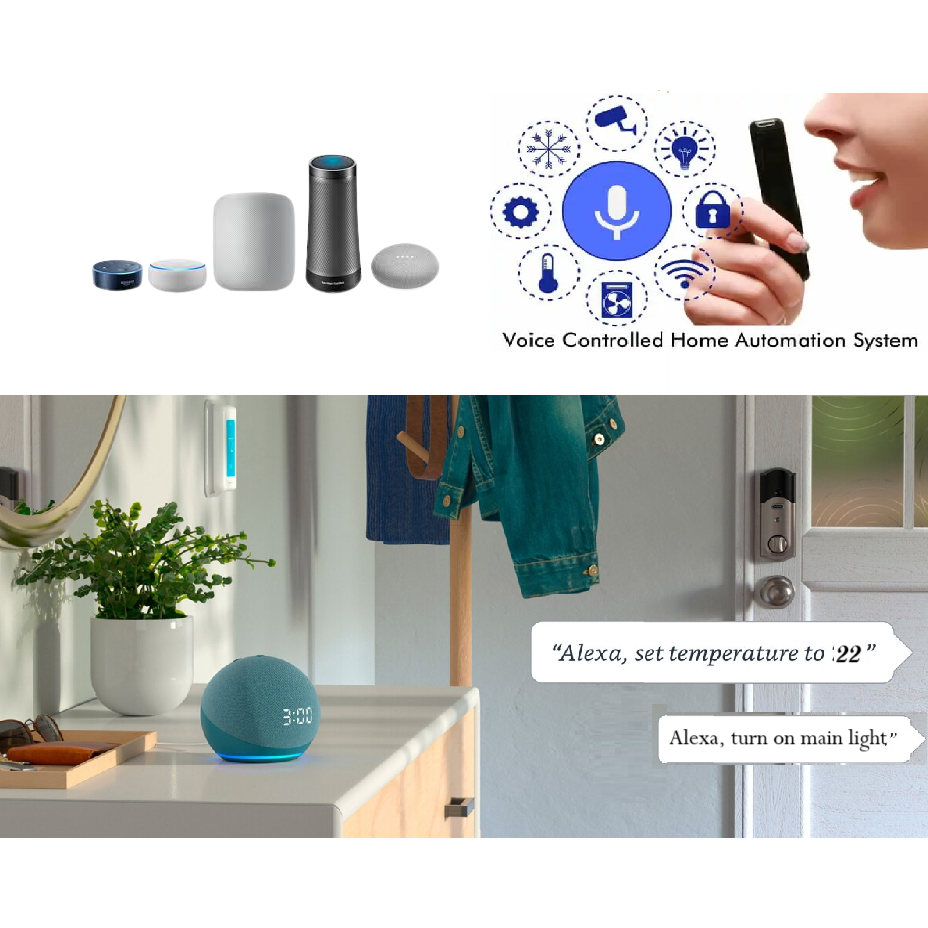
Google – Alexa – Siri – Home Kit - Voice Control – Voice Command
– Voice Access – Voice Assistant – Voice Activated… and likewise some other
word are being used for Controlling Home Automation System via Voice.
Home automation allows us to control household electrical
appliances like light, door, fan, AC etc. It also provides home security and
emergency system to be activated. Home automation not only refers to reduce
human efforts but also energy efficiency and time saving. Home automation and security
is a blessing for handicapped and old aged people enable them to control home
appliances and alert them in critical situations.
Rise of Voice-Activated Smart Homes
The voice-activated smart home is a technological marvel
in the arena of smart home technology. The advent of virtual assistants like
Apple’s Siri, Amazon’s Alexa, and Google Assistant formed the bedrock for a
revolution in human-machine interaction. As these virtual assistants became
more and more popular on smartphones, tablets, and other devices, the extension
of their potentialities to meet the needs of smart homes was only the next
logical step.
Smart home devices and ecosystems thus began integrating
voice control features, enabling users to command lights, thermostats and even
kitchen appliances with the spoken word. This transition marked a departure
from traditional interfaces like remote controls and touchscreens, offering a
more intuitive and hands-free experience.
Early implementations of voice activation were
rudimentary, but even then, there were hints of the immense potential held by
the technology. In the beginning, users could get answers to simple questions,
set timers, and play music, but the promise of a seamlessly integrated and
adaptive smart home was waiting on the horizon. The gradual expansion of voice
recognition vocabulary and the ability of contextual comprehension paved the
way for more intricate and complex voice commands.
Voice control in the smart home today is a shining
example of the relentless evolution of technology in our daily lives. It is an
ever-growing domain, still brimming with possibilities.
The Key Components of Voice-Activated Smart Home
Systems
The marvellous home automation smart home featuring
voice activation is a seamless integration of discrete components, each playing
a very important role in creating an intuitive and interconnected living space.
Here are some of the key components that make up the foundation of a
voice-activated smart home:
1.
Intelligent speakers: Smart speakers
like Amazon Echo, Apple Home Pod, and Google Home act as the nerve centres for
voice activation. They have voice assistants like Siri, and Alexa, empowering
users to give commands and receive responses.
2.
Voice assistants: The aforementioned
intelligent virtual assistants process voice commands and translate them into
actions. They learn and improve continuously, adapting to user preferences and
increasingly gaining the capability of comprehending natural language.
3.
Connected devices: Household
appliances and devices like lights, fans, HVAC systems, and locks are equipped
with connectivity features, allowing users to track and control them using
voice commands, making seamless connectivity one of the first things that
appear when you search for ‘key benefit home automation’.
4.
Connectivity: A robust network
infrastructure is essential for seamless communication between devices. Wi-Fi
and Bluetooth connectivity enable devices to connect to the internet and each
other, forming a cohesive ecosystem.
5.
Security features: As
voice-activated smart homes handle sensitive information and have total access
to the physical living space, robust security measures, including user
authentication and data encryption, are essential to safeguard privacy.
The Several Benefits of a Voice-Activated Smart
Home
Voice-activated smart home technology entails
myriad benefits. Some of its major advantages are:
·
Effortless control: Voice commands
enable users to control various smart devices and systems without the need for
physical interaction, offering unparalleled convenience in managing tasks such
as adjusting lighting, setting temperatures, or playing music.
·
Task streamlining: Voice-activated
smart homes allow for the efficient execution of routine tasks. Users can
perform multiple actions simultaneously by issuing a single command, saving
time and effort in the process.
·
Instant information retrieval: Users
can quickly retrieve information, such as weather updates, news, or calendar
events, by simply asking their voice assistant. This hands-free approach is
particularly useful when multitasking or during moments when hands are
occupied.
·
Energy efficiency: Voice control
facilitates the automation of energy-consuming devices, such as thermostats and
lights. Users can easily optimise their home's energy efficiency by controlling
devices based on real-time needs or predefined schedules.
·
Remote monitoring: Voice-activated
smart homes often include features for remote monitoring and control. Users can
check security camera feeds, lock doors, or receive alerts about unusual
activities, augmenting overall home security.
·
Continuous upgrades: Voice-activated
smart home systems often leverage cloud services, allowing for continuous
updates and improvements without requiring users to upgrade their physical
devices. This ensures that the technology remains cutting-edge and adaptable to
evolving needs.
Overcoming the Challenges of a Voice-Activated Smart
Home System
Voice control came not just with benefits. It posed
certain challenges as well. This included security concerns as well as
technical glitches while processing natural language. Overcoming the challenges
of voice-activated smart homes has been a dynamic and evolving process, driven
by technological advancements and user feedback.
A.
One major challenge was refining natural
language processing to ensure accurate and context-aware voice recognition.
Voice control in the earlier stages faced difficulties in decoding nuanced
commands, but continuous improvements in machine learning algorithms have
significantly enhanced the precision and understanding of voice
assistants.
B.
Ongoing strides in security protocols, including
robust authentication measures and encryption, have also been instrumental in
mitigating concerns about the privacy and vulnerability of voice-activated
smart homes. As the technology evolves, these efforts underscore a commitment
to refining the user experience and building a foundation for the continued
growth of voice-activated smart homes.