Home Automation Market in India (Market Research)
The home automation market in India is growing rapidly, driven by increasing urbanization, rising disposable incomes, and the growing adoption of smart technologies. Home automation, also known as smart home technology, involves the use of devices and systems to control and automate household functions such as lighting, security, entertainment, HVAC (heating, ventilation, and air conditioning), and appliances.
Here’s an overview of the home automation market in India:
1. Market Size and Growth
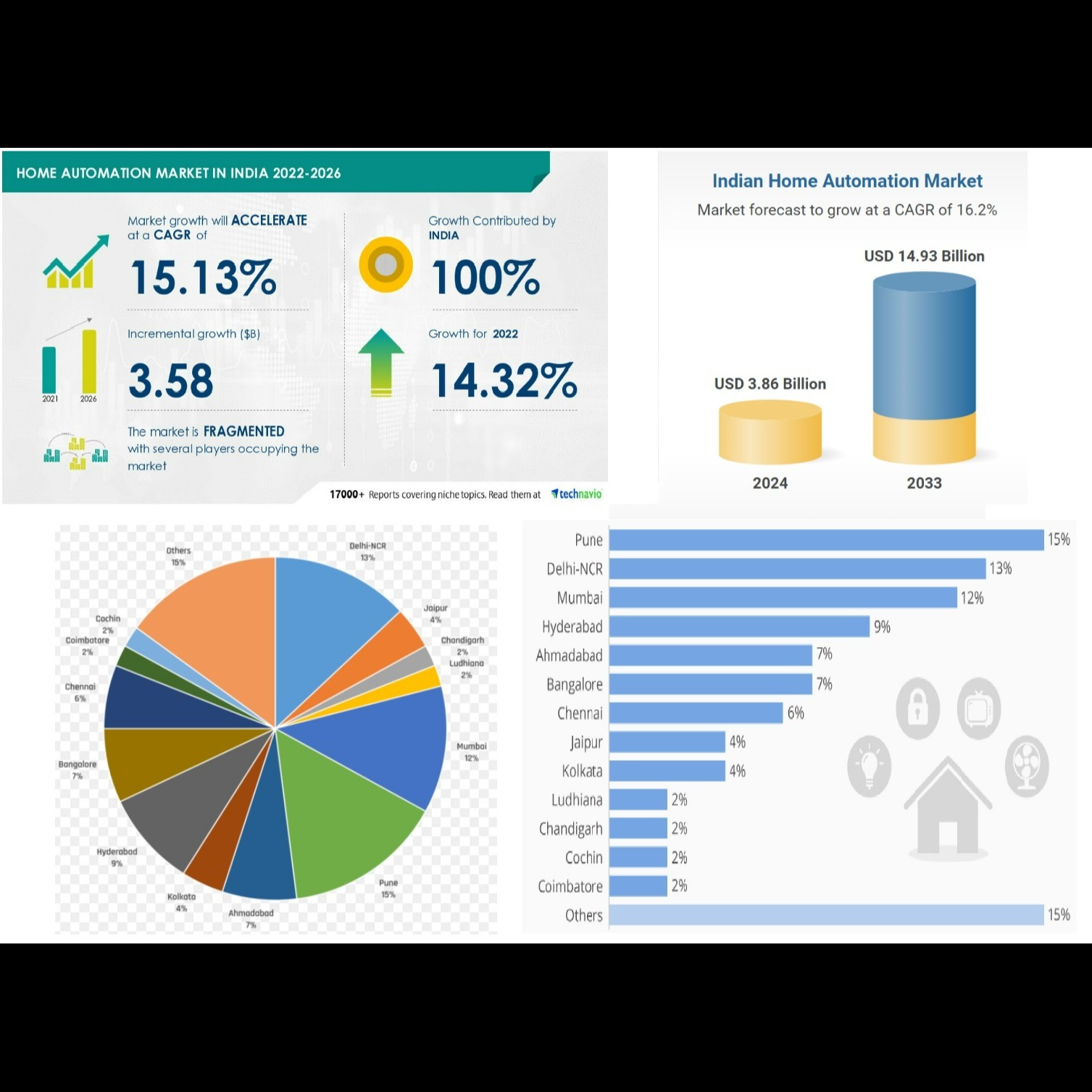
The Indian home automation market was valued at USD 2-3 billion in 2022 and is expected to grow at a CAGR of 25-30% from 2023 to 2030.
By 2030, the market is projected to reach USD 10-15 billion, driven by increasing demand for smart homes and IoT-enabled devices.
The market is still in its growth phase, with significant potential for expansion as awareness and affordability increase.
2. Key Drivers
Rising Urbanization: Rapid urbanization and the growth of smart cities in India are boosting the demand for home automation systems.
Increasing Disposable Incomes: Higher disposable incomes, especially among the middle and upper-middle classes, are enabling the adoption of smart home technologies.
Tech-Savvy Population: The younger, tech-savvy population is driving demand for connected and automated homes.
Government Initiatives: Smart city projects and government initiatives like Digital India are encouraging the adoption of IoT and automation technologies.
Energy Efficiency: Home automation systems help reduce energy consumption, which is a key selling point for environmentally conscious consumers.
Affordable IoT Devices: The availability of affordable smart devices (e.g., smart bulbs, smart plugs, and voice assistants) is making home automation more accessible.
3. Key Segments
The home automation market in India can be segmented based on product type and application:
By Product Type:
Lighting Control: Smart bulbs, dimmers, and switches.
Security and Access Control: Smart locks, CCTV cameras, door sensors, and video doorbells.
Entertainment Systems: Smart TVs, audio systems, and streaming devices.
HVAC Control: Smart thermostats and air conditioners.
Smart Appliances: Smart refrigerators, washing machines, and kitchen appliances.
Voice Assistants: Devices like Amazon Echo (Alexa) and Google Home.
By Application:
Residential: Smart homes and apartments.
Commercial: Smart offices, hotels, and retail spaces.
4. Key Players
The Indian home automation market includes both global and domestic players:
Global Companies:
Amazon (Alexa-enabled devices)
Google (Google Nest, Google Home)
Samsung (SmartThings ecosystem)
Philips (Hue lighting systems)
Bosch (Smart home solutions)
Indian Companies:
Wipro (Smart lighting and automation solutions)
Godrej (Home automation systems)
Havells (Smart switches and lighting)
Legrand (Home automation products)
Oakter (Smart home devices)
5. Challenges
High Initial Costs: The upfront cost of home automation systems can be a barrier for many consumers.
Lack of Awareness: Limited awareness about the benefits and functionalities of home automation systems, especially in smaller cities and rural areas.
Interoperability Issues: Compatibility issues between devices from different brands can hinder seamless integration.
Internet Connectivity: Reliable high-speed internet is essential for home automation, which can be a challenge in some areas.
6. Trends Shaping the Market
Voice Control: Voice assistants like Alexa, Google Assistant, and Siri are becoming central to home automation systems.
IoT Integration: Increasing use of IoT-enabled devices for real-time monitoring and control.
Energy Management: Smart energy management systems are gaining popularity for reducing electricity bills.
AI and Machine Learning: AI-driven automation for predictive and personalized home management.
5G Connectivity: The rollout of 5G is expected to enhance the performance of smart home devices.
Modular Solutions: Affordable, modular home automation solutions are becoming popular for budget-conscious consumers.
7. Regional Insights
Metro Cities: Cities like Mumbai, Delhi, Bangalore, and Hyderabad are leading the adoption of home automation due to higher disposable incomes and better infrastructure.
Tier 2 and Tier 3 Cities: These cities are emerging as growth hubs due to increasing awareness and affordability of smart home devices.
Smart Cities: Government-backed smart city projects are driving the adoption of home automation in cities like Pune, Ahmedabad, and Chennai.
8. Future Outlook
The Indian home automation market is expected to witness exponential growth as technology becomes more affordable and accessible.
The integration of AI, IoT, and 5G will further enhance the capabilities of smart home systems.
The market will likely see increased competition, leading to more innovative and cost-effective solutions.
Partnerships between real estate developers and home automation companies will drive the adoption of smart home technologies in new residential projects.
In summary, the home automation market in India is poised for significant growth, driven by technological advancements, increasing consumer demand, and supportive government initiatives. As the market matures, it will become more inclusive, catering to a wider range of consumers across urban and semi-urban areas.