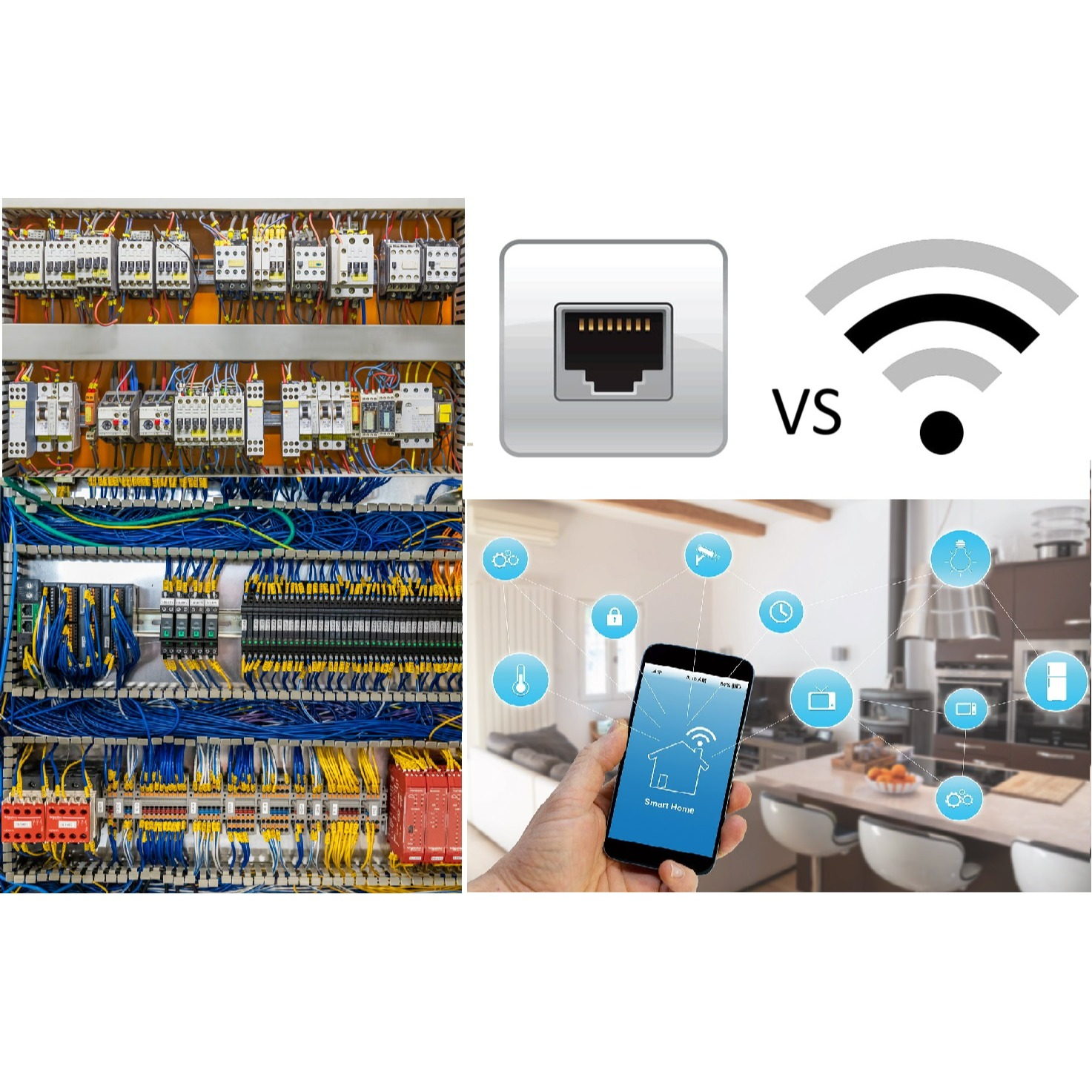
Wired Automation or Wireless Automation
Home automation is the discipline that
focuses on making houses and buildings smarter, more comfortable, and safer
through the use of technologies that enable the control and management of
various devices and functions. But how is a home automation system implemented?
What are the advantages and disadvantages of the different possible solutions?
In this article, we will try to answer these questions by comparing two types
of systems: wired home automation and wireless home
automation.
What is Wired Home Automation (Also known as Centralized Automation)?
A wired home automation system is one in which all
devices are connected to each other, as well as to the central
unit, via cables. These cables can be of various types,
depending on the communication technology used, such as bus, powerline,
or Ethernet. In a wired system, sensors, switches, and other
devices are connected through network cables, enabling centralized
control and automation.
Wired home automation requires careful design and precise
installation, often involving construction work to route
cables within the walls of the residence. This type of system is ideal to
implement when constructing or renovating a house, integrating
the wiring with the existing electrical system.
Advantages of Wired Home Automation
Wired home automation offers several advantages over
wireless home automation, including:
·
Greater reliability: cables ensure stable
and secure communication between devices, without interference
or signal loss.
·
Enhanced security: cables are more difficult
to tamper with or intercept by malicious individuals, providing
greater data and privacy protection.
Disadvantages of Wired Home Automation
Considerations when contemplating a wired system
installation include:
·
Higher cost: cables are expensive, and
their installation requires skilled labor, often involving expenses
for construction work.
·
Complex installation: Cable installation
can be intricate and may require professional intervention. Wired smart
home systems can be more complex to install and maintain compared to wireless
systems. This can make them more challenging for homeowners to use and manage
on their own.
·
Electrical hazards: Wiring smart
home systems into your home’s electrical system can pose a risk of electrical
shock or fire if not installed properly. It’s important to have a licensed
electrician perform the installation to ensure that it is done safely and
correctly.
·
Limited flexibility: Cables are fixed and
difficult to modify or expand, restricting the potential to change or add
devices or functions to the system.
·
Difficulty in existing house: If you
already have a traditional home and want to upgrade to a smart home, it can be
more challenging and expensive to retrofit a wired system compared to a
wireless one. This is because wired systems require running new electrical
wiring and installing new control panels, which can be a significant project.
What is Wireless Home Automation (Also known as Retrofit Automation)?
The alternative to wired home automation is wireless systems,
where only the central unit is connected via cables, while all
other devices are interconnected to the central unit through wireless
technologies such as Wi-Fi, Bluetooth, ZigBee, or Z-Wave.
These technologies use wireless signal to transmit data between devices,
requiring devices to have appropriate modules or adapters.
Wireless home automation involves simple
configuration and quick installation, without the need for
construction work to route cables.
This system can operate in two modes: utilizing an autonomous
central unit or directly connecting to the home router. In
the former, devices communicate through a dedicated wireless network. In the
latter, devices connect to the existing router, enabling remote control via
smartphones or tablets.
Advantages of Wireless Home Automation
Benefits of a wireless home automation system include:
·
Lower cost: wireless devices are more
affordable and do not require construction-related expenses.
·
Greater flexibility: wireless devices
are mobile and easy to modify or expand, allowing changes or
additions to devices or functions at any time.
·
Convenience: Wireless systems are
typically more convenient than wired systems, as they do not require any
installation and can be easily relocated if needed.
·
Maintenance: Wireless System can
make maintenance less and easily repairable
·
Technical Dependency: Wireless System is
easy to install and configure. User don’t require expert technical support or
dependency. User can easily re-programme the settings as per his daily need on
his own.
Disadvantages of Wireless Home Automation
Compared to wired systems, wireless systems have the
following disadvantages:
·
Lower reliability: radio waves can experience
interference or signal loss due to obstacles, distances, or other
devices generating interference, affecting device communication. Solution:
User can install Mash devices that creates strong wireless Network inside the
premises. Like Controller + Range Extender / Repeater.
·
Heavy Equipment: Due to limited space
inside electrical box or thinner wall, the retrofit devices are smaller and
slim in size. Therefore the size of relay inside the device are small. The load
capacity of it also reduces and so load bearing capacity of it has a
limitation. Solution: Connect your lighting fixture to each relay as per
its maximum capacity and then use Scene or group feature to operate them together.
Also, you can use Contactor for heavy equipment instead of directly connecting it
to this relay.
What Happens If Internet Connection Is Lost?
Some wireless home automation systems are designed to
work even without Internet Connection, or at least to ensure essential
functions in the event of absence or interruption of the connection. These
systems are based on local communication between the devices and
a central unit (hub) which manages the logic and rules of the
smart home. All the domotic elements present converge in this central unit,
forming a single automation and management entity. This element operates within
the home network which is able to communicate with the Internet, thanks to the
modem for connection to the network.
In the home automation system, Internet connection is
essentially used to:
·
Remotely control home automation devices.
·
Allow the HUB to interact with external
cloud services, which in turn communicate with the components in the house
to integrate them into the personal HUB.
When the connection doesn’t work, the home automation
systems continue to function normally inside the house, due to the hub being
integrated to all its components “locally”. These will only lose
features that require an external connection, such as:
·
It is not possible to control the devices
remotely via smartphone or tablet
·
It is not possible to integrate the house with
external cloud services
·
It is not possible to update the software and
firmware of the devices
Conclusion: How to Choose Between Wired and Wireless
Home Automation?
The decision between wired and wireless home automation
depends on various factors, including:
·
Needs: consider the functions and devices you
want to control and manage through the home automation system, in terms
of number, type, and performance.
·
Budget: evaluate how much you are
willing to spend on implementing the system, considering both material
and labor costs.
·
Situation: determine if it’s a new
construction, renovation, or an intervention to an
existing home, in order to understand the feasibility and convenience of
working on the electrical system or walls.
In general, wired home automation is
more suitable for those seeking a reliable, powerful,
and secure system, and for those who have the possibility for
construction-related work. Wireless home automation is better
suited for those looking for an economic, flexible, and discrete
system, and for those who are not inclined or able to perform extensive
renovations.