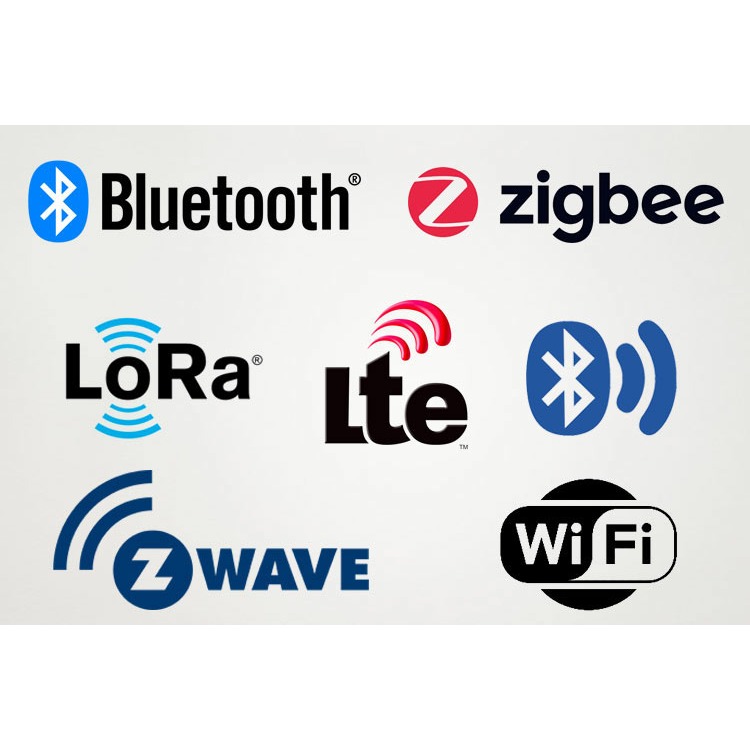
Wireless technologies used in Home Automation
Wi-Fi
Wi-Fi, based on the IEE 802.11 standard, can operate on 2.4 GHz and 5 GHz unlicensed ISM frequency bands and is one of the most widely used home automation technologies. It allows Wi-Fi-capable devices to connect directly to the internet via the Wi-Fi router. Devices can be managed individually, in a stand-alone manner, or via a central hub.
It offers a coverage range of up to 100 meters while providing reliable, high-speed, and secure communications.
The cost and power consumption requirements of Wi-Fi-enabled products are generally higher than those of other short-range wireless technologies like Z-Wave and Zigbee.
Zigbee
While it was initially used for commercial purposes, Zigbee, which is gaining popularity in residential applications, is a low-cost, low-power technology with a similar working concept to Bluetooth personal area networks. It’s designed for functions where data transfer rate is less important than power effectiveness and ad hoc channelling, and it can be deployed in a mesh network to increase coverage range.
A typical Zigbee transmission range can be up to 100 meters depending on power output and environmental characteristics, though with Zigbee Pro, it can be extended up to 1,000 meters and is used in networks that require low data rates (up to 250 kbps) and long battery life.
It operates in the 800 MHz band in Europe, the 915 MHz band in North America, and the 2.4 GHz ISM band used worldwide.
Bluetooth (BLE)
Bluetooth is based on the IEEE 802.15.1 standard and is used for short-range interconnection of mobile devices and a variety of electronic devices by creating a personal network and operating on the 2.4 GHz unlicensed ISM band.
The one downside of Bluetooth is that it has no strong security layer to prevent eavesdropping, thus falling short of security requirements compared to other wireless standards. It has commonly been used in applications requiring short-distance communications and file transfers. Common home automation applications include smart light bulbs and smart locks.
It provides a data rate of up to 21 kbps and has a transmission coverage of 10 meters or 30 feet with a data rate of 1 Mbps. Commercial Bluetooth, Class 1, is the longest Bluetooth classification that can support a range of up to 300 feet or 100 meters. The maximum communication range can vary depending on environmental factors like physical obstacles or electromagnetism.
Z-Wave
Z-Wave is a wireless radio frequency technology based on a mesh network topology that enables smart devices to talk to and connect with one another. It is a low-power, low-cost wireless technology that provides short-range interoperability among smart home systems from different manufacturers that are part of the Z-Wave association.
It can support a data rate of up to 40 kbps and a coverage of up to 30 meters, and it is designed for remote control applications in residential and light commercial applications.
It operates in the 900 MHz and 2.4 GHz unlicensed bands, with the former being used in North America and the latter being used in the rest of the world.
Radio Frequency (RF)
Radio frequency, or RFID (radio frequency identification), is another increasingly popular technology that uses frequencies ranging from 30 kHz to 10 GHz.
It has a data rate of up to 4 Mbps and can interoperate with other technologies like Wi-Fi and Zigbee.
Infrared (IR)
Simply known as IR, it’s a technology in the region of the electromagnetic radiation spectrum that carries data through infrared radiation. Infrared waves are shorter than radio waves but longer than visible light waves.
It’s common in many consumer electronics, including security systems, TV remote controls, and short-range communications.
Li-Fi
Li-Fi, short for Light Fidelity is a bi-directional wireless system that transmits data via infrared light, or LED. It can be used in explosion-hazard applications where mobile phones might pose a hazard and are therefore restricted, like airplanes or hospitals. Unlike radio frequency waves, Li-Fi can be used with very little interference.
INSTEON
It’s an integrated dual-mesh home automation network system, launched in 2005, that combines radio frequency and a home’s existing electrical wiring to control lights, sensors, and electrical devices. It’s based on mesh networking technology, where each device transmits signals individually.
UPB
UPB, which stands for Universal Powerline Bus, is another home automation technology that uses the existing powerline in the home to carry control signals, eliminating the need for additional cabling and wiring.
Thread
It’s another mesh networking technology based on future-proof IPV6 that connects smart devices like motion sensors, locks, and lights. It usually comes built into the smart devices and requires a Thread border router to connect the Thread network to the home Wi-Fi.
Matter
Matter is an open-source, secure, and unifying protocol that allows smart home devices from different manufacturers to communicate with each other. It was developed by the Connectivity Standards Alliance (CSA), an organization of hundreds of companies that create smart home products, and is not tied to any specific brand. Matter is designed to increase compatibility and create more interoperable smart homes, giving consumers more choices and better experiences.
Few more less known Technology : EnOcean; 6LowPAN; Wave2M